


STUDY MATERIALS | Gendered Disinformation
Explore BECID’s study materials and practical resources on recognising and addressing gendered disinformation, available in English, Estonian, Latvian and Lithuanian.
These study materials, developed from the BECID 2026 conference “Resilient Voices: Women & Disinformation,” explore how gendered disinformation works and how it can affect individuals and participation in public life. They examine the role of gender stereotypes, social media, emotionally charged narratives and AI-generated content, while providing practical guidance for recognising and responding to manipulative narratives.
Designed especially for galleries, libraries, archives and museums (GLAM), the materials include:
– practical questions,
– guidance,
– posters,
– an editable worksheet that can be used in collections, exhibitions, educational activities and public communication.
The materials are available in English, Estonian, Latvian and Lithuanian.
English version:
Estonian version:
Latvian version:
Lithuanian version:
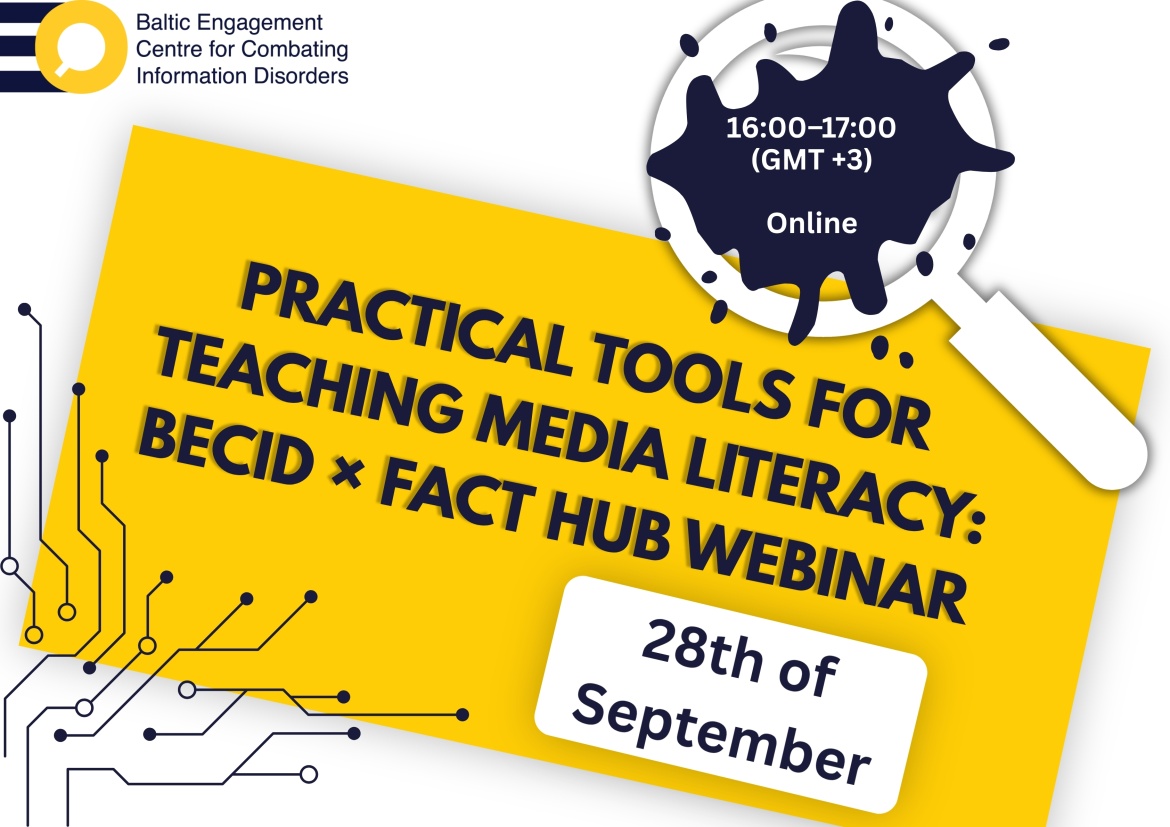
28 September 2026, 16:00–17:00
Online | In English
Register HERE.
How can we help young people recognise manipulation, navigate disinformation and become more informed and active participants in democracy?
Join BECID and the FACT Hub for an English-language webinar introducing practical media literacy resources developed and tested by Expert Forum (EFOR) in Romania. The session is open to educators, GLAM professionals, youth workers and others interested in media and information literacy and democracy education.
What to expect?
During the webinar, the Expert Forum team will introduce a selection of lesson plans and practical activities designed to make media literacy engaging and accessible to young people. The materials address topics such as disinformation and manipulation, digital skills, critical thinking and active citizenship.
Rather than focusing only on theory, the session will offer concrete examples and resources that can be adapted for use in both formal and informal learning environments, such as in schools and youth organisations or libraries, museums and other cultural and educational institutions.
The materials were developed by Expert Forum between 2024 and 2026 and tested together with social studies and humanities teachers in Romanian middle and high schools. More than 10,000 students in Romania have already used materials developed by Expert Forum in their classrooms.
A selection of the resources presented during the webinar will be available in English.
Who is the webinar for?
The webinar welcomes anyone working with or interested in media and information literacy, particularly:
- teachers and other educators;
- librarians, museum and archive professionals and other GLAM sector representatives;
- youth workers and trainers;
- media literacy practitioners and organisations;
- others working with young people, civic education or democracy education.
About FACT Hub and Expert Forum
FACT (Fighting Against Conspiracy and Trolls) is an independent, non-partisan hub launched in 2025 under the umbrella of the European Digital Media Observatory (EDMO), bringing together investigative journalists, social media experts and political analysts.
Expert Forum (EFOR) is a Romanian think tank with extensive experience in democracy and media literacy education. Since 2015, EFOR has worked with teachers in Romania and the Republic of Moldova to develop and improve learning opportunities for young people.
Practical information
Date: 28 September 2026
Time: 16:00–17:00 (GMT +3)
Language: English
Format: Online, 45-minute presentation followed by Q&A
Participation: Free of charge
How does gendered disinformation affect the people who participate in public life – and what can we do about it? These questions were at the heart of BECID’s “Resilient Voices: Women & Disinformation” conference, which brought together policymakers, journalists, researchers and civil society representatives to examine how gender and identity are increasingly used to manipulate public debate. The discussions showed that this is about more than individual attacks: gendered disinformation can silence voices, discourage participation and ultimately weaken democratic debate.
We continued that conversation with our speakers after the conference sessions. Estonian MP Hanah Lahe reflects on the role men can play in confronting gendered disinformation and on the need to create space for women’s voices and participation. Researcher Jānis Šabanovs looks at another part of the problem: the gender stereotypes circulating on social media and the way they help us organise information and perceptions. During the conference, both perspectives pointed to the same underlying challenge – stereotypes and gendered narratives do not remain confined to the online world; they can shape who feels able to participate in public debate and how that participation is perceived.
Building resilience also means looking at what can be done in practice. Augustina Zamuškevičiūtė stresses the importance of treating gendered disinformation as a wider societal issue, raising public awareness and looking for solutions across the Baltic countries rather than in isolation. Journalist Alina Lastovska, meanwhile, brings the perspective of those directly exposed to hostility and attacks in their professional lives. These experiences reinforce the need for stronger media literacy, independent journalism and support systems for people targeted by online harassment and disinformation.
There is no single response to gendered disinformation. Linda Curika highlights the importance of women supporting one another in hostile information environments and reflects on her own experience of gendered hostility online, while Hanah Lahe turns attention to the responsibilities of platforms, algorithms and legislation. Taken together, the interviews underline one of the central messages of Resilient Voices: creating a healthier information environment requires action from individuals, media, civil society, policymakers and technology platforms alike. Protecting people’s ability to speak and participate freely is ultimately part of protecting democracy itself.
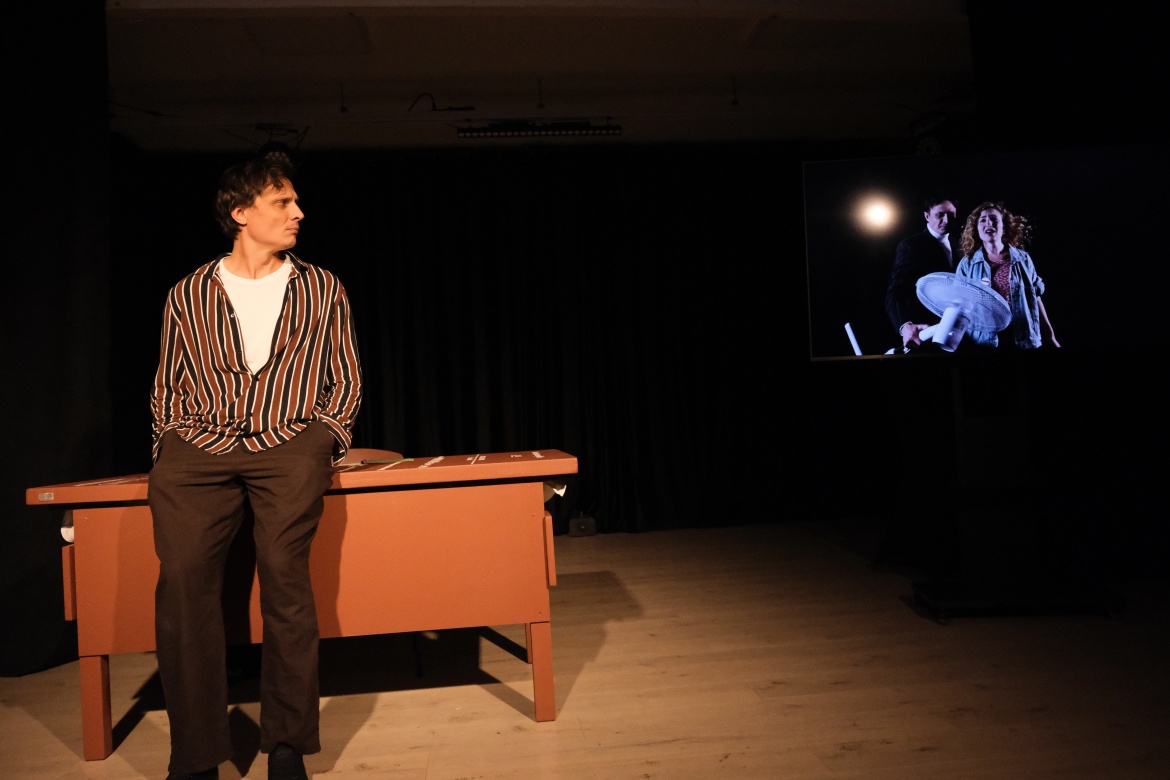
In the summer of 2026, audiences in Latvia and Lithuania were introduced to “Latvian Language Lessons” (Latviešu valodas stundas) — a sharp, ironic, yet deeply human story about language, belonging, and the feeling that one’s right to be part of society must be proven time and again.
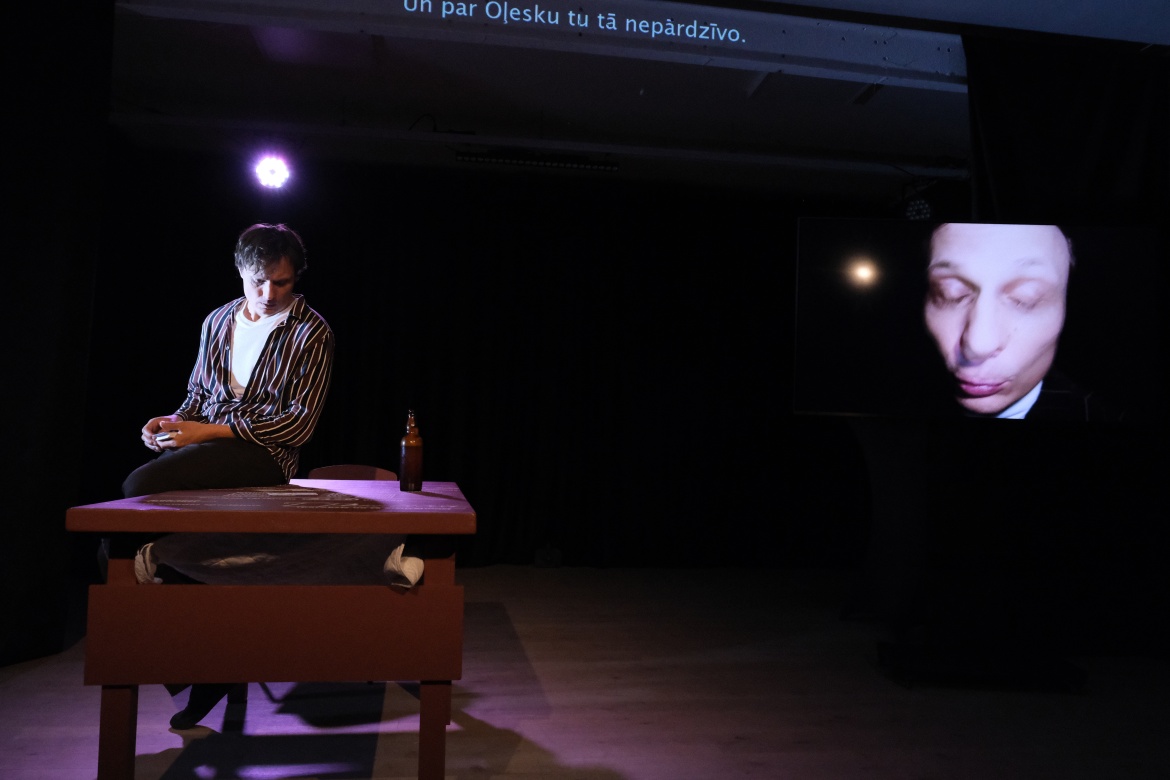
At the centre of the performance is Kolya, a man who was born in Latvia and has lived there all his life, and who is preparing to take the state language proficiency exam. Yet the formal test soon turns into a much more difficult inner examination. Kolya is forced to confront his desire to belong, his fear of failing to meet expectations, and questions about his place in the country he calls home.
“Latvian Language Lessons” is not simply a performance about language. It is a story about an exam and about belonging.
From Daugavpils to Visaginas
The performance began its journey in Daugavpils, at the premises of the New East Cultural Institute, where a dress rehearsal with an audience took place on 8 July, followed by the premiere on 9 July. The very next day, on 10 July, “Latvian Language Lessons” was performed at the LAMPA Conversation Festival in Cēsis. On 13 August, the production crossed Latvia’s border and travelled to Lithuania, where it was presented at the Draugystė Cultural Centre in Visaginas.
Altogether, approximately 325 people attended the performances in person: 80 in Daugavpils, 200 in Cēsis, and 45 in Visaginas.
Participation in the LAMPA Festival was particularly significant. The themes of the performance fit naturally into the festival’s space for discussion, bringing attention to issues that often coexist in Latvian society but do not always meet in open dialogue: identity and language, integration and loneliness, the experiences of ethnic minorities, democratic resilience, the influence of propaganda, and a person’s capacity for change.

When Language Becomes a Boundary
The production deliberately avoids presenting a simplified story of ethnic conflict or a divided society. Instead, it focuses on individual psychological experience and the questions arising from decolonisation – self-respect, belonging, and life in a situation where a person feels subject to constant evaluation.
In the performance, language is not merely a cultural symbol or a source of pride in one’s identity. It also becomes an institutional filter – a boundary between what is “allowed” and “not allowed”, between the feeling of belonging and the need to formally prove that belonging.
Kolya’s inner voice plays an important role in the performance – ironic, aggressive, humorous, and at times frightening. It provokes and helps him, humiliates him, and brings old grievances back to the surface. This voice becomes a metaphor for the way personal experience, environmental influences, propaganda, stereotypes, and unresolved social conflicts can all coexist within a single person.
It is precisely this tension that allows the performance to address complex issues not through abstract political categories, but through the lived experience of an individual.
The Conversation Continues After the Performance
For the creators of “Latvian Language Lessons”, it was important that the performance should not become a one-way statement. Following the premiere in Daugavpils, an informal conversation took place between the audience and the creative team, offering an opportunity to continue the dialogue that had begun on stage.
After the performances, audience members were also invited to complete a feedback survey. The responses gave the production an average rating of 9.8 out of 10, reflecting an exceptionally positive audience reception.
The production has also gained wider recognition. It has been included in the Latvian School Bag (Latvijas skolas soma) cultural education programme, while the theatre performance catalogue Izrades.lv lists an audience rating of 10.0.
A Performance That Continues to Live in the Public Sphere
“Latvian Language Lessons” has also attracted considerable media attention. A total of 38 publications have been compiled across the Latvian and Lithuanian media landscape and New East’s communication channels, including 25 social media posts, 11 articles, and two video features.
Documentation of the production allows it to continue reaching audiences beyond the live performances. A full video and audio recording of the performance is available, along with photo and video documentation.
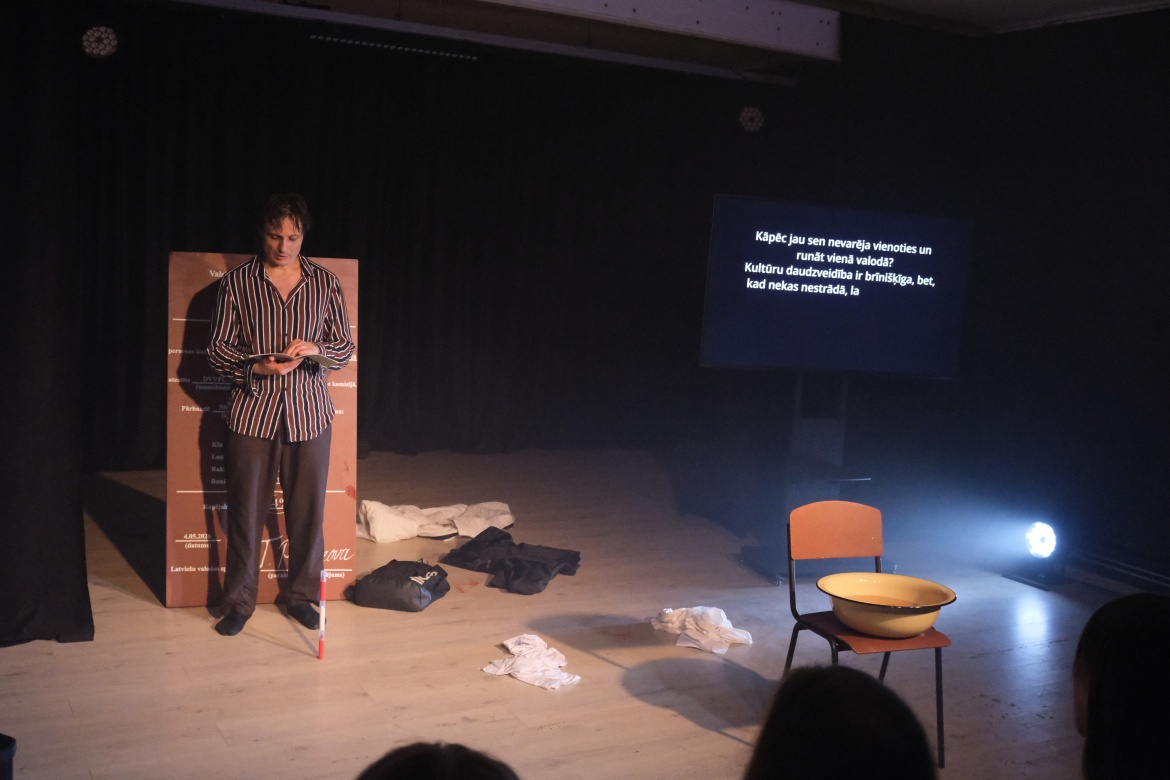
Multilingualism is not only one of the themes of the production but also an integral part of its form. “Latvian Language Lessons” is performed in Russian and Latvian, including Latvian spoken with an accent, with subtitles in Latvian, Russian, and English.
The performance runs for 90 minutes. It is not recommended for audiences under the age of 16, as it contains strong language.

Creative Team
The concept was created by Vadims Bogdanovs, who also performs the leading role. The production is directed by Edvīns Klimanovs, and the play was written by Andrejs Timofejevs.
“Latvian Language Lessons” poses a question with no single or easy answer: what does a person need in order to truly feel that they belong? Language proficiency can be tested in an exam. Far more difficult to measure is the feeling of being accepted — of not having to constantly prove one’s right to be part of the place where one lives.
This is why the story of “Latvian Language Lessons” does not end when the exam is over or when the stage lights go out. It continues in conversations among audience members and in questions about language, identity, historical experience, and the kind of society in which we want to live.
Full performance recording: Watch “Latvian Language Lessons”
How can we help people recognise manipulation in political communication—without turning media literacy into another lecture?
BECID’s new Physical MIL Intervention Guide on Elections presents the Propawheel, a playful, hands-on media and information literacy intervention developed in connection with Estonia’s 2025 local elections. The installation introduces eight common manipulation techniques—from personal attacks and labelling to “us vs. them” narratives and the bandwagon effect—and encourages participants to recognise how these techniques appear in political and everyday communication.
First piloted at the University of Tartu Library, the Propawheel has since travelled to other educational and cultural settings, demonstrating how a simple physical intervention can encourage critical reflection and conversation.
The new guide makes the concept easy to replicate: it includes practical instructions for building a low-cost tabletop Propawheel, explanations of the eight manipulation techniques, and ideas for using it in libraries, museums, galleries and archives.
The concept is also moving online. A digital adaptation is being developed in Latvia with Latvian Public Media (LSM) and Re:Baltica ahead of the 2026 parliamentary elections, with Lithuania planned as the next adaptation.
Explore the guide and get inspired to spin the wheel of media literacy!
BECID would like to draw attention to an upcoming training opportunity organised by the European Digital Media Observatory (EDMO) as part of its training series on identity-based disinformation.
The third module of the series, “People, Not Narratives: Identity-Based Disinformation about LGBTQ Individuals and Communities”, will take place online on 15 June 2026 from 15:30 to 17:30 CEST.
The session will explore how disinformation narratives targeting LGBTQ individuals and communities are created, amplified, and circulated online. Participants will gain insights into current trends, challenges, and approaches for identifying and responding to identity-based disinformation.
The training will feature experts from leading organisations working on disinformation research, media literacy, and digital rights:
- Guy Fiennes (Institute for Strategic Dialogue)
- Bulcsú Hunyadi (HDMO, Political Capital Institute)
- Ivan Ruta Cuker (CEDMO, Charles University in Prague)
- Jenni Olson (GLAAD)
- Leanna Garfield (GLAAD)
This training may be of particular interest to researchers, journalists, fact-checkers, policymakers, educators, and civil society organisations working in the fields of information integrity, digital literacy, and democratic resilience.
Date: 15 June 2026
Time: 15:30–17:30 CEST
Format: Online
Registration deadline: 15 June 2026, 12:30 CEST
BECID encourages interested members of its network to participate in the event and engage with the latest research and practical approaches to addressing identity-based disinformation.
For further information and registration, please visit the EDMO event page.
“The world of fraud has become increasingly sophisticated over time. Years ago, the police used to warn people not to buy a packaged item at a market without checking it first, because instead of a pair of trousers, you might end up with only one trouser leg. Today, we have to talk about schemes where people are lured into online scams that can cost them not only the price of a pair of trousers, but their home, their life savings, and even leave them burdened with debt.”
With these words, police officer Maarja Punak introduced the topic of BECID’s latest webinar.
A recent and particularly striking example comes from Estonia, where the Estonian Artists’ Association (EKL) announced on 18 May that it had fallen victim to a large-scale financial fraud scheme. During a press conference, EKL President Maarin Ektermann explained that on 15 May, at approximately 1 p.m., SEB Bank contacted her regarding suspicious transactions taking place through the chief accountant’s account. Transactions had been made from both the association’s Swedbank and SEB accounts. According to Ektermann, the total losses amounted to nearly €700,000.
The case highlights how convincing and sophisticated modern fraud schemes have become and underscores the importance of helping employees in memoryinstitutions recognise and prevent such threats.
Libraries, museums, archives and galleries are often places where people seek assistance with digital services or help verifying information. Older adults and individuals with less digital experience, in particular, place considerable trust in memory institution staff and frequently turn to them for advice when they encounter potential scams, misinformation or suspicious online activity.
On 1 June 2026, BECID organised another webinar for memory institution professionals across the Baltic States. As introduced, this time, we expanded into a new topic area and focused on online fraud, scams and digital safety. The webinar explored the most common threats and schemes users face today, how to recognise warning signs, and what practical steps can be taken to prevent fraud. We also discussed the broader connections between scams, the digital information environment and online security.
A total of 153 participants joined the webinar: 83 in the Estonian breakout room, 50 in the Latvian breakout room, and 20 in the Lithuanian breakout room. As usual, participants were divided into language-specific breakout sessions in Estonian, Latvian and Lithuanian.
Estonia: The Growing Sophistication of Online Fraud
In the Estonian breakout room, police officer and Head of Communications at the Police and Border Guard Board, Maarja Punak, provided an overview of the current state of online fraud in Estonia.
According to Punak, online scams are becoming increasingly sophisticated and systematic. In Estonia alone, victims have already lost approximately €8 million to fraudsters this year.
To combat the growing threat, the Police and Border Guard Board has established a dedicated fraud task force, is working closely with other public authorities, and is preparing new information materials and awareness campaigns to help different target groups better recognise scams.
Particular attention is now being given to so-called “combination scams,” where fraudsters impersonate several different organisations during a single scheme, as well as AI-generated and manipulated images, which may soon become one of the most significant emerging threats.
Although losses caused by online marketplace and sales scams have not increased dramatically in recent years, there are still cases where victims come under such intense psychological pressure that they end up selling their homes as a result of the fraud. The Police and Border Guard Board notes that many people report receiving scam emails and fraudulent phone calls, making prevention, awareness and critical thinking more important than ever.
Latvia: Understanding the Scammers’ Script
In the Latvian breakout room, Marina Ivanova from the New East Culture Institute shared her personal experience with fraud and scam tactics. She presented her story in a particularly engaging way, framing it as a theatre script.
As Marina explained, after carefully analysing both her own experience and numerous other cases, she realised that while the setting and the characters may change, the scammers’ script remains strikingly similar.
Marina also highlighted several psychological and situational factors that influence people’s behaviour once scammers initiate contact. She emphasised the importance of stopping, taking a moment to reflect, and speaking with someone outside the immediate situation, as this is often the quickest and most effective way to disrupt a scammer’s strategy and regain perspective.
Importantly, Marina stressed that anyone can become a victim of fraud, including highly educated and young people. As she pointed out, scams are not about a lack of knowledge or intelligence; they rely on cognitive manipulation, emotional pressure and carefully designed psychological tactics.
Lithuania: Fraud Cases and Data Protection
In the Lithuanian breakout room, Gertruda Pliaukštytė delivered a presentation on fraud and data breach cases in Lithuania, sharing real-life examples and insights into the evolving methods used by scammers.
Alongside recent case studies, Gertruda provided participants with practical advice on how to better protect themselves and their personal data. Particular emphasis was placed on everyday password creation and management practices, highlighting the importance of strong password habits as one of the most effective defences against fraud, identity theft and cyber threats.
As fraud schemes continue to evolve across the Baltic region, strengthening digital literacy and awareness among cultural GLAM-professionals remains essential. By equipping staff with the knowledge to recognise scams, support users and promote safe online behaviour, memory institutions can play an important role in building a more resilient and informed society.
A recent study conducted in collaboration between the Institute of Social Studies at the University of Tartu and the Baltic Engagement Centre for Combating Information Disorders (BECID) shows that libraries in Estonia have become far more than places for borrowing books. Increasingly, they serve as community hubs that help people navigate a rapidly changing digital environment shaped by e-government services, misinformation, artificial intelligence, and growing information complexity.
The study highlighted several significant challenges within today’s information ecosystem. Older adults increasingly require daily support in using digital services, while many people aged 30–50 tend to overestimate their information and digital literacy skills. Among younger people, researchers observed weakening information-search skills, lower levels of source criticism, and an increasing tendency to trust AI-generated answers too easily. In smaller communities, these issues are often intensified by a lack of both human and financial resources.
Libraries have responded creatively to these challenges by developing a range of innovative solutions. Intergenerational digital mentoring programmes, where young people support older adults in navigating digital environments, are becoming increasingly common. Libraries are also organising playful workshops focused on information search and critical thinking, while using AI tools to create educational materials and communicate more effectively with their communities. Cooperation with schools, youth centres, day-care centres, and IT students has become an important part of these efforts.
The study also revealed an important insight: people are often not attracted by the label “media literacy training,” yet they are eager to participate in workshops about illusions, memes, propaganda images, or myth-busting. In other words, people do want to learn and strengthen their skills — but they engage more willingly when the format is practical, creative, and relatable.
The findings confirm that information resilience is not built only in classrooms or through national strategies. It grows in local communities, libraries, and human relationships — in the everyday spaces where people meet, learn, and support one another.
BECID has published a new report exploring the state of Media and Information Literacy (MIL) across the Baltic GLAM sector — galleries, libraries, archives, and museums. The report highlights how libraries, in particular, have become essential community hubs for digital support and trustworthy information, helping people navigate disinformation, online scams, and the rapidly changing digital environment.
While Estonia, Latvia, and Lithuania each approach MIL development differently, the report reveals a set of shared challenges across the region: limited resources, staff shortages, fast-paced technological change, and the growing need for practical, sustainable support systems. At the same time, the Baltic countries are developing innovative ways to engage communities — from gamified learning and mobile installations to using cultural heritage materials to teach critical thinking and source evaluation.
The report also examines the evolving role of libraries as “digital lifeboats” in communities where people increasingly rely on support with e-services, digital safety, and identifying trustworthy information online. Alongside these opportunities, the report raises important questions about staff workload, data protection, and the long-term sustainability of digital support services.
Bringing together research findings, practical examples, and regional best practices, the report offers a valuable overview of how cultural and memory institutions can strengthen democratic resilience and help communities respond to information disorders and disinformation.
Read the full report here:
A-Review-of-Media-and-Information-Literacy-Materials-and-Approaches-in-the-Baltic-GLAM-Sector-1
PDF · 2 MB
A recent study conducted in collaboration between the Institute of Social Studies at the University of Tartu and the Baltic Engagement Centre for Combating Information Disorders (BECID) shows that libraries in Estonia have become far more than places for borrowing books. Increasingly, they serve as community hubs that help people navigate a rapidly changing digital environment shaped by e-government services, misinformation, artificial intelligence, and growing information complexity.
The study highlighted several significant challenges within today’s information ecosystem. Older adults increasingly require daily support in using digital services, while many people aged 30–50 tend to overestimate their information and digital literacy skills. Among younger people, researchers observed weakening information-search skills, lower levels of source criticism, and an increasing tendency to trust AI-generated answers too easily. In smaller communities, these issues are often intensified by a lack of both human and financial resources.
Libraries have responded creatively to these challenges by developing a range of innovative solutions. Intergenerational digital mentoring programmes, where young people support older adults in navigating digital environments, are becoming increasingly common. Libraries are also organising playful workshops focused on information search and critical thinking, while using AI tools to create educational materials and communicate more effectively with their communities. Cooperation with schools, youth centres, day-care centres, and IT students has become an important part of these efforts.
The study also revealed an important insight: people are often not attracted by the label “media literacy training,” yet they are eager to participate in workshops about illusions, memes, propaganda images, or myth-busting. In other words, people do want to learn and strengthen their skills — but they engage more willingly when the format is practical, creative, and relatable.
The findings confirm that information resilience is not built only in classrooms or through national strategies. It grows in local communities, libraries, and human relationships — in the everyday spaces where people meet, learn, and support one another.
On 7 April, we held another BECID webinar for memory institution professionals across the Baltics, bringing together 136 participants in total from Estonia, Latvia, and Lithuania. This session focused on data protection in the digital environment, addressing both its practical and legal aspects in everyday work.
During the webinar, we explored how the digital sphere is not separate from everyday life but an integral part of it, where personal data protection plays a central role. We discussed how to collect, process, and store personal data lawfully, and how to balance service accessibility with user privacy in institutions such as libraries, museums, galleries, and archives.
The Estonian session featured Gunnar Gabriel Einlo from the Estonian Data Protection Inspectorate, who provided an overview of key data protection principles and legal bases. His presentation covered what constitutes personal data and data processing, as well as the conditions under which data processing is lawful. Particular emphasis was placed on the principles of purpose limitation and data minimisation.
We also addressed practical aspects of handling data securely in daily work. Topics included processing user data in libraries, data retention practices, and the use of cloud services, along with associated risks. Common risk areas were discussed, such as the use of personal email accounts for work purposes and ensuring the security of public computers in libraries.
In addition, we covered the rights of data subjects and the responsibilities of organisations, including the need for clear internal policies, staff training, and preparedness for data security incidents. The session also provided practical cybersecurity recommendations and discussed risks related to digital tools, social media, and emerging technologies.
The topic was further explored in country-specific breakout sessions. In the Latvian group, we focused on broader data protection challenges in the digital environment, emphasising both organisational and individual responsibility, as well as the importance of critical thinking. In the Lithuanian group, discussions centred on everyday work scenarios, including handling visitor data, and included examples of data breaches and their potential consequences.
The webinar is part of the BECID training series, which introduces approaches to media literacy development in the GLAM sector (Galleries, Libraries, Archives, Museums) across the Baltics.
Our next webinar will take place on 1 June, where we will expand the focus to cover fraud and scams in the digital environment.
Register to the next webinar here.
On 30 March, BECID held the first session in its new training series, bringing together BECID team members and external participants for an introductory workshop on AI and open-source intelligence (OSINT).
The session was led by Anna Danielyan, OSINT analyst currently engaged in contractual work with Graphika as a Navigator and alumna of the University of Tartu’s Disinformation and Societal Resilience MA programme. The workshop was opened by BECID project manager Gretel Juhansoo, who invited participants to suggest tools and topics for future trainings so the series can respond directly to the needs and interests of the community.
During the one-hour session, Anna introduced the fundamentals of OSINT workflows and demonstrated how open-source methods can be used to investigate suspicious online content. Using practical examples, she walked participants through an image-led attribution process that included reverse-image search, domain registration checks, page-source analysis, and amplification tracking, showing how these steps can help connect content to known influence operations.

The training also covered how to present findings in a clear and actionable way. Participants were introduced to concise reporting formats built around key findings, significance, evidence of online activity, and source links, helping translate raw information into usable analytical insight.
A major part of the session focused on the ethical and legal boundaries of OSINT work. Anna emphasized that responsible use of AI and OSINT tools depends on compliance with privacy and platform rules, including GDPR and the Digital Services Act. She also highlighted the importance of avoiding the collection, storage, or sharing of illegal material, and noted that content such as terrorist propaganda or child sexual abuse material must be reported to the relevant authorities rather than downloaded or redistributed.
The workshop further addressed operational security (OPSEC) for researchers and journalists. Participants discussed device protection, browser choices, anti-malware practices, the cautious use of VPNs, and the creation of secure research identities for monitoring online spaces.
In the second half of the session, Anna introduced advanced search techniques, including Google dorking, and provided an overview of Russian and pro-Kremlin influence ecosystems. She outlined different categories of actors, from overt state media to covert networks and amplifiers, and presented examples of known operations such as Storm-1516 CopyCop, Operation Overload, and the Pravda/Portal Kombat network.
To conclude the training, participants were offered a voluntary home assignment on influence activity related to Estonia and the Baltic region. Anna invited participants to analyze a recent spike in narratives on X on 27 March and offered to provide individual feedback on completed assignments.
BECID will continue the training series with future sessions shaped by participant suggestions, helping ensure that the programme remains relevant, practical, and useful for those working on resilience against disinformation and influence operations.